Cover
Front cover
GARNETT
opening cleaning and carding machinery
(Blue cover with large black letter G and line drawing of an opening/carding machine line.)
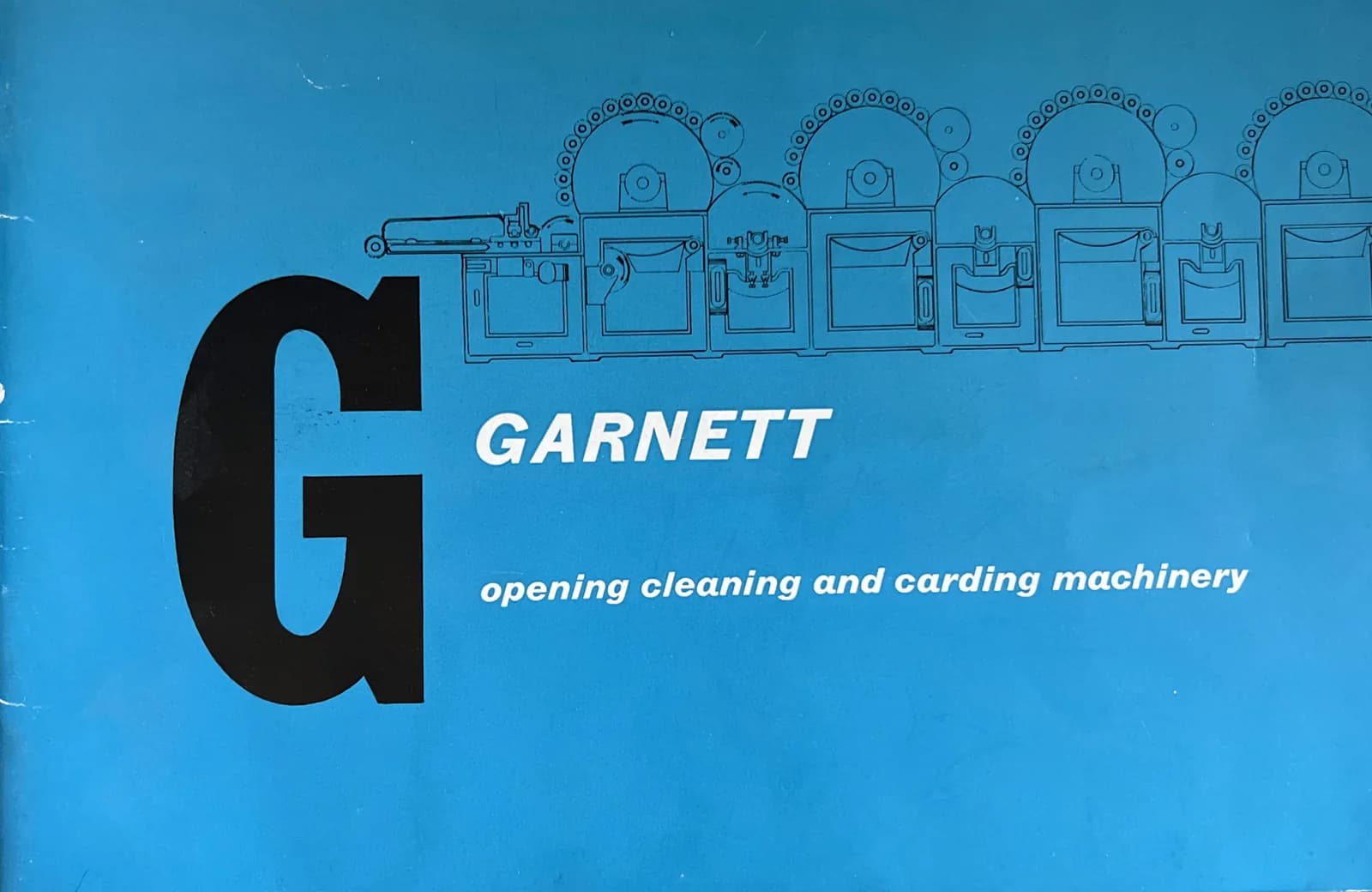
A landscape catalogue from P. & C. Garnett Limited, Engineers and Machinists, Cleckheaton. It does not print a year. The wording in it places it in the mid-20th century (after 1950).
Download the print PDFThe cover reads “GARNETT — opening cleaning and carding machinery”. It is a landscape catalogue from P. & C. Garnett Limited, Engineers and Machinists, Cleckheaton, England. Page ii gives the telegraphic address “Garnett, Cleckheaton” and the telephone numbers 3306 and 3307. Page 36 carries the printer’s code J.W./C.W. 5585.
The catalogue does not print a year. It is mid-20th century (after 1950). The introduction is headed “More than one hundred years” of specialisation. The firm was founded in 1850, so that heading places the catalogue after 1950. The text also names rayon, Terylene and nylon, and it prints metric measures beside the imperial ones. No single year is stated.
It is the Cleckheaton machinery range as the firm described it after a century in the trade: Class A and Class B Garnett machines, the model opener or sample card, Garnett breasts, a cleaning-waste machine, a new-model preparer or knotbreaker, the heavy shredder, pickers and willey machines, rag pulling and burring, a high-production twin-doffer plant, and a sisal and hard-fibre wadding plant.
Page 1 says the waste-opening machines predominate in four continents. The twin-doffer plant on page 30 is cited in the catalogue as Patent No. 323696. Page iii lists trades the machines served, from felt and rayon to rope, wadding, mattress and asbestos.
40 leaves, in order. Select a page for the full image. Arrow keys move through the open viewer.
GARNETT
opening cleaning and carding machinery
(Blue cover with large black letter G and line drawing of an opening/carding machine line.)
P. & C. GARNETT LIMITED Engineers and Machinists, Cleckheaton, England
SPECIALISTS IN MACHINERY FOR OPENING, CLEANING AND CARDING TEXTILE FIBRES AND WASTES OF EVERY DESCRIPTION
Telegrams: "Garnett, Cleckheaton" Telephone: 3306 and 3307 Cleckheaton
of specialisation in the making of Waste Opening, Cleaning and Carding Machinery would not in itself represent a claim to the support of the Textile Industry. But when one hundred years have been spent in supplying this class of machinery all over the world, in constantly devising and testing new ideas in design and construction, in keeping our works and plant efficient and up to date — then discriminating buyers have genuine cause to consider our machines.
Garnett machines can be described as machines that "know" their work and perform it. Skilful workmanship and the finest materials account for their rigidity, accuracy and durability. Their high productive capacity and excellent pulling are the result of clever design and care in detail. The fact that our Waste Opening Machines predominate in four continents emphasises the soundness of our policy.
Most people today, in business and in private life, find it wise to deal with specialists. We SPECIALISE in machinery for the preparatory treatment of all textile fibres; that is to say, Teasing, Willeying, Cleaning, Waste Opening and Carding Machinery.
It is possible that the illustrations and facts — given as fully as possible in this catalogue — throw no light on some textile problem peculiar to the reader. In that case, do not hesitate to write to us; our unique experience in working every variety of fibre is at your service.
We invite all those who are interested to visit our works; on such occasions points of detail can be discussed, the capabilities of our machines can be demonstrated, and trials can be made with material brought by the visitor.
Wools: Crossbred, Merino and East Indian.
Worsted Wastes Cotton Wastes Staple Fibres Woollen Wastes Silk Wastes Schappe Silk Hosiery Wastes Rayon Wastes Ramie
Rags: Suiting, Hosiery, Cotton, Silk, Rayon.
For Waddings: Pulled Rags, Woollen and Cotton; Cotton Wastes; Rayon Rags; Cotton Linters; Pulled Bagging.
Human Hair · Asbestos · Cow Hair · Cow Tail Hair · Old Press Cloths · Sisal Fibre · Long Jute · Roller Lapping · Ropes
Most of these open better if they are pulled first, but some varieties can be fed straight on to the Garnett machine, which in this case is usually fitted with a breast.
| Section | Contents | Pages |
|---|---|---|
| SECTION 1 | Introduction | 1 |
| The Garnett Machine — Class "A", "B" | 4–7 | |
| Model Opener or Sample Card | 8 | |
| SECTION 2 | Line Drawings of Garnett Machines | 9–12 |
| Garnett Breasts | 13–15 | |
| SECTION 3 | Cleaning Waste Machine | 16 |
| SECTION 4 | The Preparer or Knotbreaker — New Model | 17 |
| Heavy Shredder | 18–19 | |
| SECTION 5 | Super Picker | 20 |
| The Cleaning, Opening and Blending Machine | 21 | |
| Opening and Blending Machine | 22–23 | |
| The Needle Point Teaser | 24 | |
| The Wash Bowl Willey | 25 | |
| Patent Cleaning Willey | 26 | |
| The Fleece or Cott Opening Machine | 27 | |
| SECTION 6 | Rag Pulling | 28 |
| SECTION 7 | Burring Rollers and Apparatus | 29 |
| High Production Twin-Doffer Garnett Machine | 30 | |
| Garnett Machinery for the making of Wadding and Padding from Sisal and other hard fibres | 31 | |
| Double Doffer | 32 | |
| Horizontal Lapper | 33 | |
| Sisal Picker or Breaker | 34 | |
| Garnett Machine fitted with Automatic Feed and Blamire Lapper | 35 | |
| Re-clothing | 36 | |
| List of Trades using our machines | (iii) |
Function of
THE GARNETT MACHINE
The machines are made with one, two, three or more swifts, which, with their component parts, are self-contained. The material is brought to the machine either by hand or by an automatic feed, and after passing the feed rollers (A) is subjected to the first Opening process on encountering the teeth of the licker-in (B). The points of this clothing pass through the material held by the feed rollers, and carry forward any loose fibres liberated from their grip. Continuing its way through the machine, the material is carried to the swift (D) the points of whose clothing are keener than those on (B) or on the divider roller (C). The latter supplies the swift with material and prevents the licker-in from choking. The swift is provided with a series of workers (I). These workers present the sharp points of their teeth to those of the swift (D). This action is largely responsible for the opening and straightening of the material passing through the machine. (A fancy roller (E) lifts the material from the cylinder into its own clothing, and a roller (F) strips the fancy).
The points on the stripper are engaged with the points on the fancy, and by the latter’s high speed the material is deposited on the stripper. The stripper acts both as a worker and as a conveyor of the material to the swift; a doffer (G) revolving slowly, transfers the material to the second swift (if two or more are employed).
The last doffer is cleared by a rapidly-oscillating doffing comb (H).
Setting gauges are sent with each machine. The 11/000 gauge is used by many people for setting all the rollers of the machine, but when fine materials are to be treated, it is better to use a finer gauge, say 8/000 or even 5/000 (especially for the fancy and fancy stripper) on the finishing parts of the machine.
When using this fine gauge, the teeth must not be allowed to touch. Each roller should be turned all the way round by hand to prove that all the points are clear before the machine is set in motion. Care must be taken to tighten all the screws on the carriers.
If the teeth of the rollers are allowed to touch, the point of the wire is spoilt and the opening and carding of the machine suffer.
A six-speed gear can be fitted so that the speed of the feed can
OPENING | hard-twisted worsted, woollen, cotton, silk and rayon wastes.
CARDING wool, cotton, silk, rayon, ramie, human and other hairs for spinning,
OPENING AND CARDING cotton linters, cotton wastes, pulled rags, pulled
bagging, cow hair, etc., for felts, waddings and paddings.
be run in the lowest asi To open fine threads the feed ought to
Ae Bi Hee opening is good enough, and a larger output is desired, the feed can be run faster.
heels for each doffer and for each set of workers are sent out Seth cach chines thorough carding, the workers and doffers should be run slowly. To obtain a less thorough opening with a higher output, speed up the workers and doffers.
A Garnett machine can also be fitted with STRIPPERS and WORKERS (see line drawing, page 11). This arrangement is recommended where the materia! needs really good carding, for the stripper gives the swift and worker a second chance.
Again, the machine can be equipped with WORKERS and STRIPPERS in cases where a really large output is desired, for the strippers carry the material straight forward to the swift (see line drawing, page 11).
S, Pulleg
lowest ed, the
nt Out ul be fed up
ROLLERS The various sections of the machine consist of a series of rollers made of cast iron from the best brands, accurately turned and balanced. The fast-running fancy rollers are carefully tested at 2,000 revolutions per minute.
CLOTHING Our Garnett saw-tooth wire, with which the rollers are clothed, is made of the best material. Its special design ensures accuracy and security in fastening on to the rollers, and lends itself to easy renewal.
SHAFTS All rollers, when not mounted on ball bearings, are fitted with case-hardened shafts, ground true on the most accurate grinding machinery.
BEARINGS All the smaller rollers are fitted with flanged bushes, which set tightly into the roller end, and protect the shaft and bearing from fly and dirt. The bushes are held in position by adjustable carriers, which ensure perfect alignment. The pedestals for swifts, when not mounted on ball bearings, have a long bearing for solid grease lubricant.
FRAMES The frames are massively built to withstand all strains and to carry the running parts with the minimum of vibration — an important point where such fine setting is essential.
THE DRIVING PULLEYS The driving pulleys (fast and loose) are usually 15” diameter, but larger or smaller pulleys can be fitted if desired. They should be run at 220 to 300 revolutions per minute, according to the class of material to be opened. The driving pulleys are always on the right-hand side of the machine, unless the client asks for them to be on the left.
ERECTION All machines are erected, each part adjusted and marked in its place before leaving our works.
CARDING
A Garnett machine is commonly held to be a “tearing and opening machine” and to be incapable of true carding.
This delusion has two origins; most Garnett machines have a number of small workers instead of workers and strippers, and the cylinders run at very high speeds (30” cylinder makes about 300 r.p.m.) for the purpose of bursting hard threads.
To deal with the first point; we have made Garnett machines with workers and strippers for about thirty years and are ready to build such machines at any time.
As for the cylinder speed, there is nothing fixed about this — according to the material and the result desired, the cylinder speed may vary between 140 and 300 r.p.m. Most kinds of wool need gentle handling, while cotton will stand harsher treatment. Owing to the fact that we can now offer a much greater range of clothing for our machines, we do not consider that there is need for high cylinder speeds as a general rule, but exceptional materials demand exceptional treatment.
In recent years we have carded many materials on Garnett machines (or Garnett cards) with excellent results, both with regard to the quality of the work and the production, which is usually distinctly higher than that from an ordinary carding machine.
Appropriately clothed, intelligently set and speeded, a Garnett machine will card any textile fibre and card it well.
This machine, which has been entirely re-designed, is probably the most versatile of all our machines.
The one-cylinder model, when strongly clothed, is an excellent preparer or shredder. For carding pulled bagging, it is one of the best machines in existence.
Almost every type of rayon waste can be opened on this machine. The three and four-cylinder machines are essentially waste openers; after the material has been prepared and washed, they will open fine single and two-fold worsted wastes. We recommend these machines for pulled hosiery clippings of every variety — wool, cotton, silk and rayon.
| Width (ins.) | Floor Space (ft. ins. × ft. ins.) | Dia. of Driving Pulleys (ins.) | Size of Motor recommended (H.P.) | Approx. production per hour (lbs.) | Revolutions per minute | Weight Gross (cwts.) | Weight Nett (cwts.) | |
|---|---|---|---|---|---|---|---|---|
| With one swift | 24 | 7 6 × 5 6 | 15 | 3 to 4 | 10–35 | 150/250 | 46 | 40 |
| 36 | 7 6 × 6 6 | 15 | 15–50 | 150/250 | 52 | 46 | ||
| 48 | 7 6 × 7 6 | 15 | 20–65 | 150/250 | 58 | 51 | ||
| 60 | 7 6 × 8 6 | 15 | 25–85 | 150/250 | 64 | 56 | ||
| With two swifts | 24 | 10 6 × 5 6 | 15 | 4½ to 6 | 10–35 | 150/250 | 60 | 53 |
| 36 | 10 6 × 6 6 | 15 | 15–50 | 150/250 | 69 | 62 | ||
| 48 | 10 6 × 7 6 | 15 | 20–65 | 150/250 | 79 | 72 | ||
| 60 | 10 6 × 8 6 | 15 | 25–85 | 150/250 | 98 | 83 | ||
| With three swifts | 24 | 13 6 × 5 6 | 15 | 7½ to 9 | 10–35 | 150/250 | 93 | 75 |
| 36 | 13 6 × 6 6 | 15 | 15–50 | 150/250 | 105 | 87 | ||
| 48 | 13 6 × 7 6 | 15 | 20–65 | 150/250 | 117 | 99 | ||
| 60 | 13 6 × 8 6 | 15 | 25–85 | 150/250 | 130 | 112 |
(Motor H.P. is printed once per swift group as a range spanning the four widths.)
| Width (ins.) | Floor Space (ft. ins. × ft. ins.) | Dia. of Driving Pulleys (ins.) | Size of Motor recommended (H.P.) | Approx. production per hour (lbs.) | Revolutions per minute | Weight Gross (cwts.) | Weight Nett (cwts.) | |
|---|---|---|---|---|---|---|---|---|
| With one swift | 36 | 9 3 × 7 0 | 15 | 4 to 5 | 15–50 | 140/285 | 65 | 54 |
| 48 | 9 3 × 8 0 | 15 | 20–65 | 140/285 | 74 | 61 | ||
| 60 | 9 3 × 9 0 | 15 | 25–85 | 140/285 | 81 | 68 | ||
| With two swifts | 36 | 13 6 × 7 0 | 15 | 6 to 8½ | 15–50 | 140/285 | 110 | 92 |
| 48 | 13 6 × 8 0 | 15 | 20–65 | 140/285 | 119 | 101 | ||
| 60 | 13 6 × 9 0 | 15 | 25–85 | 140/285 | 135 | 116 | ||
| With three swifts | 36 | 17 9 × 7 0 | 20 | 9 to 12½ | 15–50 | 140/285 | 158 | 129 |
| 48 | 17 9 × 8 0 | 20 | 20–65 | 140/285 | 175 | 145 | ||
| 60 | 17 9 × 9 0 | 20 | 25–85 | 140/285 | 200 | 166 | ||
| With four swifts | 36 | 22 0 × 7 0 | 20 | 15 | 15–50 | 140/285 | 190 | 163 |
| 48 | 22 0 × 8 0 | 20 | 15 | 20–65 | 140/285 | 216 | 185 | |
| 60 | 22 0 × 9 0 | 20 | 15 | 25–85 | 140/285 | 267 | 224 |
(Motor H.P. for one-/two-/three-swift groups is printed as a range spanning the three widths; four-swift rows each show 15.)
This is our “heavy-weight” machine — it gives an immediate impression of strength and solidity. The larger swift and the greater number of workers show that the machine has been designed to deal with hard-twisted thread wastes of every description.
The two and three-cylinder machines may be said to do the same work as three and four-cylinder machines of the class “A” type. The class “B” machine, with four cylinders, will open the finest and hardest threads.
For synthetic wastes, the latest machines are fitted with a strong breast part in front, the clothing on the third and fourth cylinders of the Garnett being extremely fine.
This is a model machine that really works, a machine that is relatively cheap, occupies little floor space and requires little power.
The framework is of cast iron, which ensures the smooth running of the rollers and enables them to be finely set. The cylinder and fancy are mounted on ball bearings.
The machine can be used for various purposes:—
SAMPLE CARD For mills producing fancy mixtures, such a machine is invaluable for obtaining shades in the dyehouse and for blending and shading in the cardroom.
WOOL CARDING This machine is very suitable for small users in such countries as Bulgaria, Yugoslavia, Rumania, Finland, China, India and Persia, for carding coarse wools and delivering the carded wool on to a drum or roll, so that it can be spun on the hand-spinning wheels. Matted and tangled wools can be fed straight on to the machine without preparation.
ROVING WASTE The machine is an effective opener for roving waste, and will be found very economical in small mills, where the quantities of waste are not large.
WOOL WASTES This machine is suitable for the softer single yarn wastes in small woollen and hosiery mills, where only a little waste is handled.
| Width (ins.) | Floor Space (ft. ins. × ft. ins.) | Dia. of Driving Pulleys (ins.) | H.P. Required | Approx. production per hour (lbs.) | Revolutions per minute | Weight Gross (cwts.) | Weight Nett (cwts.) |
|---|---|---|---|---|---|---|---|
| 12 | 4 3 × 3 9 | 12 × 3 | 1 | 6–9 | 150–250 | 12 | 10 |
| 18 | 4 3 × 4 3 | 12 × 3 | 1 | 9–14 | 150–250 | 13½ | 11 |
| 24 | 4 3 × 4 9 | 12 × 3 | 2 | 12–19 | 150–250 | 14½ | 12 |
| 30 | 4 3 × 5 3 | 12 × 3 | 2 | 17–25 | 150–250 | 15½ | 13 |
x
SECTION 2. Line drawings of GARNETT machines
SHS
pLonor
ana
Garnett Machine with Breast; large Second Licker-in. Fancy and Fancy Stripper.
With Workers and Strippers,
Garnett Machine with Workers and Strippers, and Fancy and Stripper over Swift. Garnett Machine with Breast, Workers and: Strippers and Double Doffers.
Line drawings of GARNETT machines
Top: Garnett Machine with Breast, Divider and second Large Licker-in. With Workers and Strippers, and Fancy and Stripper over Swift.
Bottom: Garnett Machine with Workers and Strippers and Breast.
(Captions as printed under the two profile drawings.)
FIBRE BREAKAGE Most woollen spinners associa nl > Garnett G A R N E BEIGE B R E A ST waste-opening machine, used for opening hard-twisted threads of all kinds and capable of a very severe opening action, and often conclude that a Garnett breast will be equally drastic in its effects. A few figures will show that this conclusion is wrong; the surface
The Garnett breast is a standard fitting on American speed of a class B Garnett machine, opening hard waste, is usually 2,200 feet per minute, and Continental carding sets, but it is only in recent while a Garnett breast cylinder seldom exceeds 500 feet per minute. The setting of the years that it has become popular in Great Britain and rollers on the Garnett machine is also much closer, being 11/1000” or a 31s G even over
there is still much prejudice against it. the first cylinder.
CLEANING OR FETTLING When we claim that Garnett wire needs less fettling than other forms of card clothing, we do not mean to say that it NEVER needs to be fettled. It is sound practice to clean the Garnett breast clothing at regular fixed intervals, say every hundred hours, every month and so on, according to the type of blend, although we know of instances where Garnett breasis run for six months and more without fettling. SUITABILITY FOR VARIOUS MATERIALS Garnett breasts are suitable for dealing with almost every type of SCOURED blend, and for certain classes of unscoured wools that are not of a very greasy nature. There need be no hesitation in using a Garnett breast on the FINEST MERINO WOOLS, since fibre breakage is determined by setting and speeding rather than by the “‘rigidity” or “flexibility” of the clothing. Incidentally, most modern breast clothings are imitations of Garnett wire.
6™ WORKER
Yo ) 34" STRIPPER
24™ DOFFER [7 = Af) \—(F— 44” CLEARER
y
Sov 3x2 KNIFZ BLADE
QO“ UNDER LICKERIN
Large Garnett Breast, with 40” dia. cylinder and four pairs of workers and strippers, fancy and stripper, and doffer. For
BS working long wools, this type of breast is fitted with three pairs of workers and strippers.
i i
Drawing No. 1067. 20” Breast.
This machine is specially designed for preparing materials for cleaning or wiping waste. It can also be used for opening old ropes, bagging, waste jute and so on.
The machine is strongly built, and is fitted with two pairs of feed rollers, strong gearing, chain-driven drawing-off rollers, a sliding wheel with a lever for throwing the feed out of gear, and a belt guide. The machine illustrated is shown fitted with workers and strippers.
Cast steel gearing wheels can be supplied if they are desired.
| Width (ins.) | Floor Space (ft. ins. × ft. ins.) | Size of Pulleys (ins. × ins.) | H.P. required | Revolutions per minute | Weight Gross (cwts.) | Weight Nett (cwts.) |
|---|---|---|---|---|---|---|
| 36 | 12 9 × 6 9 | 26 × 7 | 16 | 250 | 105 | 92 |
| 42 | 12 9 × 7 4 | 26 × 7 | 18 | 250 | 122 | 107 |
| 48 | 12 9 × 7 10 | 26 × 7 | 18 | 250 | 140 | 120 |
| Width (ins.) | Floor Space (ft. ins. × ft. ins.) | Diameter of Driving Pulleys (ins.) | H.P. required | Production per hour (lbs.) | Revolutions per minute | Weight Gross (cwts.) | Weight Nett (cwts.) |
|---|---|---|---|---|---|---|---|
| 24 | 8 6 × 6 6 | 18 × 6 | 10 | 120–180 | 450 | 47 | 38 |
| 36 | 8 6 × 7 6 | 18 × 6 | 12 | 180–240 | 450 | 54 | 44 |
| 48 | 8 6 × 8 0 | 18 × 6 | 15 | 240–300 | 450 | 58 | 48 |
Wastes prepared on this Knotbreaker are partially opened, which prevents damage to the clothing of the subsequent Garnett machine that might occur if wastes were fed in a wild and knotted condition. Long unprepared wastes cannot be fed directly into an automatic feed, but if prepared by this machine, an automatic feed can be used to save labour and ensure even flow.
OTHER USES By altering the relative speeds of the swift and feed, certain cotton rags can be shredded into a fibrous state, so that they can be mixed with cleaning wastes. By slight modifications, the machine can be made to pull bagging, rope ends, flax and jute wastes and carpet ends; or it can be used for preparing and cleaning kapok and other material used in the furniture and upholstery trades. Silk spinning wastes and silk rags can also be prepared on the Knotbreaker.
SPECIAL FEATURES There are two pairs of very strong feed rollers which grip the wastes very firmly and do not permit the swift to draw through long lengths. The swift has a diameter of 30″; this makes wrapping of the swift very unlikely.
The driving wheels on the feeder part of the machine are made from steel. They are machine-cut from the solid, and are appropriately strong.
The doffing brush roller is mounted on ball bearings to give easy running and to maintain the necessary speed. It is important that the brush should keep up a steady speed, or the swift will not be cleared.
The rollers are covered with very strong cast steel wire, hardened at the points.
This is a new machine, intended to take the place of the Knotbreaker and the small Shredder (Class "A" type with 20″/500 mm. dia. cylinder) which we have built for so many years, and is ideal for use where tough synthetic materials are to be processed, and a high output is required.
The machine is fitted with a steel feeder sheet. The first two feed rollers are cut with a diamond-shaped tooth and are covered with a hard-chrome deposit. The second pair of feed rollers, and the clearer, are fitted with porcupine rings on a keyed shaft, with strong steel teeth. The bottom feed roller clearer is a 5″ dia. full brush. A metal detector can be fitted to the feed rollers, which will switch off the feed motor in the event of metal getting into them. The Heavy Shredder is of massive construction, with a 3″/75 mm. shaft in the main cylinder. Worker and fancy brackets are of steel, with heavy gearing all round, and the machine has an unlimited range. A few of its many uses are as follows:—
JUTE BAGGING: The Shredder follows a Picker or Rag Pulling machine and will give a bit-free product, of good staple length, at a high rate of output. For this type of work, the Shredder is fed by a large hopper feed. Output 1,000/1,200 lbs. or 500 kgs. per hour.
WORSTED THREADS: This machine is an excellent preparer of worsted threads before garnetting.
Rayon, Terylene, Nylon wastes: the Shredder is used for opening and preparing these materials before garnetting. The use of a powerful Cutting-Machine is ESSENTIAL for these wastes. Output 100/200 kgs. per hour.
COTTON RAGS: There are SOME types of cotton rags which shred very well; a certain percentage of these shredded rags can be mixed with long thread waste to make cleaning waste.
SISAL, COIR AND ALGERIAN FIBRE: The Shredder can be fitted with a camel back lapper or horizontal lapper and used for making pads, either for interlacing or rubberising.
Due to the very large output of the Heavy Shredder machine, maximum efficiency is obtained when used in conjunction with a fan, and the material is blown to a condenser or bin.
ROLLERS All rollers are covered with special saw tooth Garnett wire, and all shafts are of case-hardened mild steel running in Oilite bearings, unless otherwise stated. All shafts, excepting those of the swift, are recessed at each end, and fitted with end shield bearing bushes.
THE FEED ROLLER ASSEMBLY is driven by a 3 h.p. totally-enclosed motor, coupled directly through a worm reduction unit. The motor is operated by a "Stop, Start and Reverse" push button, with the control panel mounted on the feed table side.
SWIFT DRIVER 15 h.p. motor with V rope pulleys. In order to conserve floor space, the motor can be mounted under the feed table, on the left-hand side of the machine.
DOFFER DRIVE From the swift shaft through a variable drive gear.
WORKER DRIVE Chain drive from the doffer shaft. Speeds controlled by variable speed gear.
DELIVERY BEATER driven from fancy stripper by laminated V belt, or alternatively, a normal oscillating doffing comb can be fitted.
POWER Machine 15 h.p. Feed 3 h.p. FLOOR SPACE 9′ 8″ long (2.94 m.) × 9′ 5″ wide (2.87 m.) GROSS WEIGHT 4 tons 12 cwts. 2 lbs. (4674.8 kilos.) NETT WEIGHT 3 tons 18 cwts. 3 lbs. (3964 kilos.)
™ SECTION 5. SUPER PICKER
WORKING DESCRIPTION
The material to be opened is placed on the feed sheet and is conveyed to the single large-diameter steel-pinned feed roller. This roller works in a steel dish which is fitted with a special alloy steel knife blade, over which the material is passed. As the material passes over this blade, the teeth of the downward running cylinder open the material and carry it forward to the discharge outlet.
DRIVE The feed rollers and sheet are driven by 1 B.H.P. motor, through a reduction gear box controlled
by a stop, start and reverse switch.
The swift, by V ropes from a 30 B.H.P. motor. The swift runs at 750 r.p.m.
FLOOR SPACE 8’ 6” (2591 mm.) long xX 6’ 0” (1829 mm.) wide (excluding motor).
GROSS WEIGHT 45 cwts. (2250 kgs.). Nett weight 37 cwts. (1850 kgs.)
PRODUCTION = 1000/1500 lbs. (500/700 kgs.) per hour, or more on jute bagging which has been pre-sorted. The production is dependent on the skill of the operator.
STITT Tal TT TTT Ty 9 10 |
‘asaapmmamncsmr nvwmmmnnummccnans iit
Swift 26” (660-4 mm.) over points. 4 Bearers 25” (635 mm.) dia. 14” (38 mm.) thick M.S.
This is, trade fi: differer
The fit rollers |
24 C.S. Lags 3’ 4” X 2” X 14” (1016 mm. X 51 mm. X 32 mm.) Here a
Feed Roller 103” (260 mm.) dia. over points. 84” (216 mm.) dia. Steel Tube Roller.
£45. Creeper Rollers 44” Ga. (114 mm.)
Cast Steel Dish with Steel Blade. Blade 3’ 6”, (1067 mm.)
1194 Drop forged teeth. \ 3” (16 mm.) dia. FOR V through shaft. A mor
colour:
Hinge for FOR \ Top Cover. ; A bett
FOR ¢ A higl FOR §£ ¢ This r
PROD 600 t cleani
The r detail
Floor
Vee aS
This is a strong and simple machine, of particular interest to the woollen trade for, on certain classes of material, it does the work of two or three different machines, giving a notable saving in time and labour.
The fibre is preserved, because there are no opposing spiked or toothed rollers to damage it.
Here are some of its uses:—
FOR WOOLLEN MANUFACTURERS A more thorough opening, dusting and blending of various qualities and
colours.
FOR WORSTED COMBERS A better opening of fleeces and matted wools.
FOR COTTON SPINNERS AND WASTE DEALERS
A higher degree of opening and cleaning for cotton and wastes.
FOR BEDDING AND WADDING MANUFACTURERS
This machine is excellent as a shaker and cleaner of cotton linters. C L i= A N | N G
PRODUCTION OPENING and
600 to 1,200 lbs. per hour, according to the degree of opening and
cleaning required. B L [S N D | N G M AC Fl | N E
The machine is built with one or two cylinders; slight alterations in detail can be made to suit a customer’s needs.
Floor space required for machine: 13’ X 8’ for single machine.
—_— Orr Poa WN Ld TR a YT we pa ST ARR RICE ce RE AIAN SS eI
ep een eee
OPENING AND BLENDING MACHINE
This is a strong and simple machine, of particular interest to the woollen trade for, on certain classes of materials, it gives a larger production than machines at present in use for the same purpose, giving a notable saving in time and labour.
The fibre is preserved, because there are no opposing spiked or toothed rollers to damage it.
Here are some of its uses:—
FOR WOOLLEN MANUFACTURERS A more thorough opening and blending of various qualities and colours.
PRODUCTION 600 to 2,500 lbs. per hour, according to the degree of opening and
cleaning required. Floor space required for machine:—13’ x 8’ for single machine. Power required:—15 h.p. for 48” wide machine. Weights:— 48” machine. Gross 56 cwts. Nett 50 cwts. OPENER, SHAKER OR MIXER This is a most useful machine for the preliminary opening of large quantities of strong materials. It can be used for:— 1 Opening strong fleeces, washed or in grease. 2 Opening or mixing dyed cotton, or wool in a matted state. 3 Opening mungo as it comes from the bale. 4 An all-round shaker or mixer. The machine is of simple and strong construction, very reliable, and has a very large output. When it is used in conjunction with a conveyor, unnecessary handling is eliminated and labour is saved. As the material is thoroughly circulated through the fan and in the tubes, the blending is much improved.
48 ins. wide 36 ins. wide Gross weight 56 cwts. 50 cwts. Nett weight 49 cwts. 44 cwts. Floor space OF OX Sie As 96 2 xe An Power required 1 SSH: 124 H.P.
Sy AS] ES eee DO ee Ee) ES eee eee
This type of Teaser is admitted to be the best for the teasing and mixing of wools and wastes for the woollen trade.
The swift and workers are covered with hardwood lags fitted with steel-pointed pins, similar to those used on a flax card.
This type of clothing combs rather than breaks the fibre, and material from this
machine has a loftier and better-opened appearance than that from the ordinary teaser.
The machine is really well made and embodies many refinements, such as self- aligning, self-oiling or ball bearings to the swift and delivery beater.
Long metallic creeper sheets are fitted to the feed, so that an oiling machine can
be used. The wheels are machine-cut throughout. The grids are made so that they can be drawn out from the side.
54 in. wide 48 in. wide Gross Weight 95 cwts. 89 cwts. Nett weight 78 cwts. 72 cwts. Cubic measurements 505 cu. ft. 480 cu. ft Horse power 10 10. Floor space occupied 16°70" X10" =: 160" 9 6”
This machine is very useful for the preliminary opening and cleaning of wools which are heavy with dirt and sand, before they are passed into the wash bowls. The machine consists of two feed rollers which can be set close together or wide apart, followed by two cylinders fitted with round pegs or with blades, which beat the wool against the sectional bar grids. These bar grids are far better than the ordinary large grids, for they can very easily and quickly be removed for cleaning. This machine is also made 60” and 72” wide.
Gross weight 48” machine 80 cwts. Nett weight = 65 cwts. Floor space OM Ox 67 24 Power required 10 h.p.
Output: This can be regulated to that of the wash bowls. Speed: From 250 to 400 revolutions per minute, according to the nature of the wool to be treated.
25
THE WASH BOWL WILLEY
This machine has been designed as a good all-round cleaning machine, capable of dealing with all sorts of dirty wools, wastes and rags, strippings and droppings from worsted cards, and other kindred materials. The action is automatic, and we believe that it is in advance of every other cleaning machine in these respects: —
1. The production which can be obtained without damage to the
fibre. 2. The ease with which the machine can be kept clean.
Materials which can be treated:— East Indian or lime wools. Strippings from worsted cards.
Mohair, cow hair, goat hair. Scutcher droppings. Dirty cashmere. Carbonised rags, dirty cotton rags, etc.
The machine works as follows:—
With a two-cylinder machine, a charge of material passes between two feed rollers to the first cylinder, which runs in a downward direction. The cylinder beats the material against special D-shaped grids. When the material has been beaten round a certain number of times, the inter- vening door lifts and the material is discharged into the second cylinder, where the beating process continues.
Cleaning. On account of the special grids, the dirt is easily knocked out of the material, and it is long before the grids are themselves choked. The top of the machine is fitted with hinged doors, so that the interior can easily be cleaned. Machine with one cylinder Floor space PP SEK SY WY Extra space for dust fan AV OY Power required, including fan, about 124 h.p. Gross Weights, including fan and pipes 76 cwts. Nett Weight 60 cwts. Machine with two cylinders Floor space OMe Sa 44 Extra space for dust fan AD YY XK I Power required, including fan, about 15 h.p. Gross weight 110 cwts. Nett weight 91 cwts.
THE C
Gd) ye
LEANING WILLEY
Made with one, two or three cylinders
* « e ee SS
This machine works on the same principle as a Gill Box — that is to say, the whole length of the pin penetrates the mass of fibres, drawing them
out and aligning them.
In all previous machines of the Gill Box type, the speed of the fallers was not great enough to give a large production, and at the same time the driving mechanism was not strong enough to deal with matted and felted materials in large quantities.
This machine makes use of a strong and simple mechanism (PATENTED) for driving the fallers, which allows a very high speed to be obtained. This mechanism is almost NOISELESS, which is another advantage over the ordinary Gill Box or Strong Box.
GREASY WOOLS This machine improves scouring and mixing. Since it allows no UNOPENED PIECES to pass through and since it aligns the fibres, it lightens the work of the card and saves the clothing from damage. After scouring, the wool has a better appearance than if it had been through a machine of the Willey or Breaker type.
SCOURED WOOLS If the wool is to be carded, the same benefits are obtained as are mentioned above. From any point of view, the appear-
ance of the wool is improved.
MANNER OF WORKING As is the case with most opening machines, the material is laid on a feed sheet, which carries it to the feed rollers. The feed rollers are followed by the faller bars, which penetrate the mass of fibres and comb them out. The material is taken from the fallers by
a second endless sheet.
There are five faller bars, each of which passes through the material 200 times per minute, making a total of 1,000 faller strokes each minute.
The feed rollers are fitted with a drive which gives four effective speeds, so that the action of the machine can be varied to suit different materials. Generally speaking, hard cotts are fed slowly, and softer fleeces quickly.
PRODUCTION: Up to 1,000/1,200 lbs. per hour on greasy wools. Up to 500 lbs. per hour on scoured wools.
HORSE POWER : 10.
Speed of the driving pulley : 480/500 r.p.m.
Size of the driving pulley : 16” x 4”.
iBloon space 39434 << 5/ 10%
Weight of the machine : About 18 cwts. nett; about 21 cwts. gross.
27
THE FLEECE and CO OPENING MACHINE
WIDE MODEL
TT
“ SECTION 6.
RAG PULLING MACHINE
This is the ‘donkey engine” of the textile trade and, despite its prosaic appearance, its noise and clamour, its extreme simplicity, it is remarkably effective, needing very little maintenance. Its primary purpose is to prepare rags for the Garnett machine or the
card, and it is often used for bursting wastes, as an alternative to the Knotbreaker.
The machine can be supplied with or without the basic delivery arrangement and dust extraction fan shown in the illustration, and
if desired, can also be fitted with a .\ patented 3-speed and reverse gear box, or a variable speed drive as shown.
The main frame is strongly built in fabric-
ated steel, braced for rigidity, with feed rollers of best quality carbon steel, running in extra-wide brass
bearings. A safety guard, of simple design, is fitted, which stops the feed if disturbed in any way. The top feed roller can be fitted with independent drive, thus obviating choking of the feed by overload
— an important feature which can be fitted to existing machines. Power required 20 - 50 h.p., dependent on materials.
COMPARATIVE OUTPUT PER HOUR
SHODDY Working Medium Fine hosiery width Cloth and knitted
Large mixed
Ko NE | Clips
91 181 1
200 400 259 600 241 ee tor =
362
533 330 800
Se ees ees Wee es es es es es es cc. = ES
; ROLLERS
and APPARATUS
If you find any difficulty with burry wools, consult us. We have had almost as much experience in the designing and construction of burring appliances, as we have with waste opening machines.
The secret of success in the construction of this burring apparatus is great accuracy in workmanship, and attention to the minutest details.
To these points we give the most careful attention.
We can send you drawings of the various types of burr rollers and burring apparatus that can be applied to worsted carding machines.
We can clothe the fine burr roller with wire to any degree of fineness required.
Patent No. 323696
Since we introduced our first Twin Doffer machine, the growth of the trade in upholstery wadding brought a demand for machines that were even more productive. This demand is met by our latest two-cylinder Twin Doffer machine, with a first cylinder 30″ diameter and a second cylinder 20″, with a middle doffer 20″ diameter and two doffers to the second cylinder.
This machine has a very large output (up to 450 lbs. or 200 kg. per hour), and does relatively better carding than the older machines. It would be idle to pretend that these machines card well, in the sense understood in the cotton spinning trade, but they do produce a wadding that suffices for most upholstery purposes.
HOPPER FEED The machine is fed by a very large automatic feed with weighing motion, which is capable of dealing with great weights.
CAMEL BACK LAPPER The Camel Back Lapper has been re-designed in every respect, and is now built almost entirely of steel. The action is smooth and regular, and the lapper is able to match the fastest speeds of the doffers. This lapper is simple to follow and clean, a point that will be appreciated by practical men. The lapper is fitted with two pairs of compression rollers, which give a very well-pressed felt.
The Camel Back Lapper is fitted with a Batt Slitter, to cut the wadding to any desired width, and with a cut-off device to cut the wadding to length. The cut-off can be followed by a folder, which folds the cut pads, making them easier to handle; the folder is used mainly in mattress factories, since wadding is usually sold in rolls.
Power: One 15 h.p. motor for the Garnett machine, Automatic feed and Camel Back; one 3 h.p. motor for the bottom sheet of the Camel Back, cut-off, etc.
| Floor Space for the whole plant, with folder | 31′ 3″ × 23′ 11″ |
| Floor Space for the whole plant, without folder | 31′ 3″ × 16′ 5″ |
| Gross Weight, with folder | 265 cwts. |
| Nett Weight, with folder | 226 cwts. |
| Cubic Content | 950 cubic feet |
Materials that can be worked on the machine: Cotton and cotton wastes, such as "fly", "blowings" and "strips"; linters; mixtures of pulled jute and cotton wastes; mixtures of pulled rags and pulled jute.
Blamire Lapper with cutting knives: This Blamire Lapper has also been re-designed and strengthened in every way. The drive has been made more efficient, and the framing is braced to withstand "whip". This Blamire Lapper is now capable of running at fast speeds, ensuring that the best possible work is obtained from the High Production Garnett.
| Floor space | 35′ 8″ × 14′ 0″ |
| Gross weight | 53 cwts. |
| Nett weight | 47 cwts. |
| Cubic content | 200 cubic feet |
The plant illustrated here produces padding from sisal, sisal tow and coir, etc. The sisal must, of course, have been teased and shortened on a separate machine, which we also supply (shown on page 34). The sisal pads, on account of their strength and toughness, are used in inner-spring mattresses, spring cushions, etc., and are often covered with a layer of cotton felt.
The plant consists of the following machines:—
Sisal Breaker, fitted with Ceiling Condenser.
Special Large Hopper Feed This can be supplied with or without weighing motion.
Special Sisal Garnett Machine, strongly built and clothed with carbon steel GARNETT wire with hardened points.
Camel Back Lapper of our latest steel construction fitted with extra- heavy compression rollers.
Cutting Device This is fitted with four cutting knives, turning slowly, which cut the padding to the desired width and also give a clean edge.
Tear-off Attachment This cuts the wadding to the desired length. Owing to the great length of the sisal fibre, it is not possible to give an absolutely clean cut.
Folder The folder delivers a folded pad, easy to handle and of a length suitable for a mattress. The folder is recommended only for
mattress manufacturers; makers of wadding and padding usually sell the material in rolls.
Production 750 - 850 lbs. (350 - 400 kg. per hour)
Power One 15 h.p. motor for the Garnett machine; one 3 h.p. motor for the bottom part of the Camel Back Lapper.
Gross Weight (including large hopper feed) 215 cwts. (10,750 kg.) Nett Weight (including large hopper feed) 190 cwts. (9,500 kg.)
Length 31" 4” Width (without Folder) ee? ay Width (with Folder) 224 92
Maximum height NO? 3”
GARNETT MACHINERY FOR THE MAKING
OF WADDING AND PADDING FROM SISAL AND OTHER HARD FIBRES
a i ot gy rg na
New Model 24/30 High Production Garnett machine.
This machine was designed for the high output of short and medium staple materials. The machine is characterised by simpli- city, rugged strength, a minimum number of rollers, simplified drives and reduced friction. Only the feed rollers and the under licker-in or lumper roller are on plain bearings (of the “Oilite” self-lubricating type), all other rollers being on ball bearings.
All the workers, strippers, fancies and fancy strippers are of the same diameter (8” or 200 mm.) and all these rollers are balanced to run at high speeds. This system makes possible a great, almost infinite, number of roller combinations and reduces maintenance costs.
Another unusual feature of the machine is the MIDDLE DOFFER, which runs clockwise, with the teeth pointing in an anti-clockwise direction — the effect of this is that the first doffer is the stripper to the first fancy. The first cylinder is thus completely stripped at each revolution, with the result that it remains clean for long periods, and can handle more stock.
DOUBLE DOFFER
Extra attachments and refinements :
METAL DETECTOR for the feed rollers, which will knock out the feed, when a piece of metal makes contact between two feed rollers.
WASTE SCRAPER This device can be fitted to scrape waste and droppings towards the hopper feed, or to a side conveyor in the floor.
VARIABLE SPEED DRIVES can be fitted to the fancies, and to the lap former and back doffers.
PRODUCTION
Cotton wastes and linters — 400/600 lbs. or 180/270 kg. per hour.
rie wool and cotton rags — 500/800 lbs. or 225 to 360 kg. per our.
Pulled jute — 600/900 lbs. or 270/400 kg. per hour.
—
The Horizontal Lapper has been designed to run in conjunction with Garnetting machines, to occupy the minimum of floor space and is suitable for ALL natural and synthetic fibres, forming mh even lap with economic production capacity. The Lapper can be made to fit to any width of Garnett or Carding machine and can be used as a separate unit, or for “in line” production.
DESCRIPTION The Horizontal Lapper consists of three endless creeper sheets.
(A) Delivery Sheet from the doffer. (B) Intermediate Jigger Sheet. (C) Bottom Jigger Sheet.
Sheet (A) conveys the sliver from the doffer, delivering to sheet (B) at a point situated over the centre line of the bottom floor apron (D). This intermediate jigger sheet slides horizontally backward and forward, and has a travel of half the width of the lap. The sheet (B) delivers the sliver on to the bottom jigger sheet (C). The latter is fitted with delivery guide plates and twin 5” diameter ironing rollers. This sheet also moves horizontally backward and forward, and has a travel equal to the full width of the lap being formed. These sheets are so geared together that the sliver from the doffer flows through the Lapper at a constant speed, giving an even and unbroken sliver. As the material falls on to the floor apron, the twin ironing rollers roll each sliver into a compact lap. The inter- mediate jigger sheet acts as a compensating sheet; as it moves in one direction it stores up the sliver, and in the reverse direction it discharges the stored sliver, thus maintaining an even flow.
PICKER OPENER FOR SISAL, ETC.
AL and other long, strong is | t Picker Opener for SIS aenee ane of exceptional strength and robustness, and has a large output.
The machine consists of a feed sheet, two Pairs me a heya rollers, the first pair fluted and the second pair covered with massive steel teeth in steel rings. These teeth are almost unbreakable, but if an accident should occur, the rings can easily be slipped off the shaft and replaced. The cylinder is fitted with heavy steel curved teeth, which intersect with the bottom feed roller and lash through the fibres, giving a thorough Opening and teasing. The toothed feed rollers also intersect with one another, thus having a firm hold on the material. The cylinder, running at over 900 r.p.m., throws off the material by centrifugal force. The machine can be arranged to deliver into a large box or chamber, but, owing the very dusty nature of the sisal fibres, it is
better to fit the machine with one of our large ceiling-type condensers, as illustrated.
OUTPUT Up to 900 lbs. per hour, or about 400 kg.
POWER Owing to the tremendous friction set up between the fast running cylinder and the long sisal fibres, the machine needs a 25-30 h.p. motor. The feed sheet is fitted with a friction clutch arrangement, so that the feed rollers stop if the machine is fed too heavily.
FLOOR SPACE For machine 36” or 900 mm. working width:—
8’ long by 7’ wide; 2-60 metres by 2:20 metres.
WEIGHTS = Gross weight : About 45 ewts or 2,250 kg. Nett weight : About 40 cwts. or 2,000 kg.
GARNETT MACHINE
fitted with Automatic Feed and Blamire Lapper
The single cylinder Class “A” Garnett machine is one of the most popular models, and is so well known that it needs little description. The latest type has been improved in a number of details — it has a 12” diameter top licker-in and heavier feed rollers, as well as larger worker rollers. The feed rollers and the workers are fitted with “Oilite” self-lubricating bushes; the comb box is of the SKF
high-speed type.
The machine is built in four widths: 60”, 72”, 78” and 84” (1.50 m., 1.80 m., 2.00 m. and 2.10 m.).
The main uses of the machine are the carding of pulled jute bagging, mixtures of jute, and hair and jute and coarse wool, out- put varying between 120 and 350 lbs. per hour (55 kg. to 160 kg.). The hopper feed is of the large-capacity type; the Blamire lapper has been made more rigid, with steel channel sides, and is fitted with a variable speed control of the bottom or take-up lattice.
RECLOTHING
The secret of success with pulling, opening and carding machinery is to keep the clothing in really good condition. We have noticed that the most successful firms are those who pay the most attention to the clothing of their machines.
“Spare the wire and spoil the sliver” is more than an epigram; it is a truism. One cannot card well with blunt, worn clothing, for the material slips between the rollers and is not opened.
Many spinners and manufacturers do not appreciate another advantage of frequent reclothing INCREASED PRODUCTION. When the wire is keen, the workers can be run fast and production is high; as soon as the clothing becomes old and worn, the workers must be set closer to the cylinder and run slower in order to obtain the same degree of opening.
No sensible person runs a car with the tyres smooth and gripless; many forget that the same principle applies to machines.
kish, Egyptian
: bl and other vegetable rsted trade for
and other wools. recovering wool from “burr ase Burring machines have declined in popularity for several Teasons— improved methods of wool carbonising have made their use uncommon in the woollen trade, while worsted combers have preferred to improve the card itself as a de-burring machine, by the addition of one or more Morel rollers, tighteners, etc. During the last few years, the “Peralta” apparatus has dealt burring machines another knock, by reason of its efficiency as a crusher of all types of burrs and vegetable matter. These remarks do not indicate that we are not ready to build burring machines for certain purposes, where they might be of real value — we have, in the past, built six or seven types of burring machine, for both coarse and fine wools, and shall be glad to quote for them.
J.W./C.W. 5585
Felt Hat Makers · Press Cloth Manufacturers Rayon Spinners · Hosiery Spinners · Spinners of Human Hair Angora Fur Spinners · Hair Spinners Rope Makers · Twine Makers Wool Felt Makers · Roofing Felt Makers Jute Felt Makers · Cow Hair Felt Makers Wadding Makers · Mattress Manufacturers Flax Spinners · Cleaning Waste Manufacturers Quilt Makers · Asbestos Manufacturers
(Plain white/grey cover, stained; no printed text.)